Improving Registration Conversion Through UX Content

Reduced user drop-off in a high-friction registration flow by identifying moments of confusion and implementing targeted UX content and structural changes - without modifying the underlying system.

Role

UX Designer / Content Strategist

Employer

The Technical Association for the Pulp and Paper Association (TAPPI)

Platform

Cvent Registration System

Skills

UX writing, flow optimization, data analysis, stakeholder collaboration

The Problem

The registration experience had a critical drop-off point for non-member users.

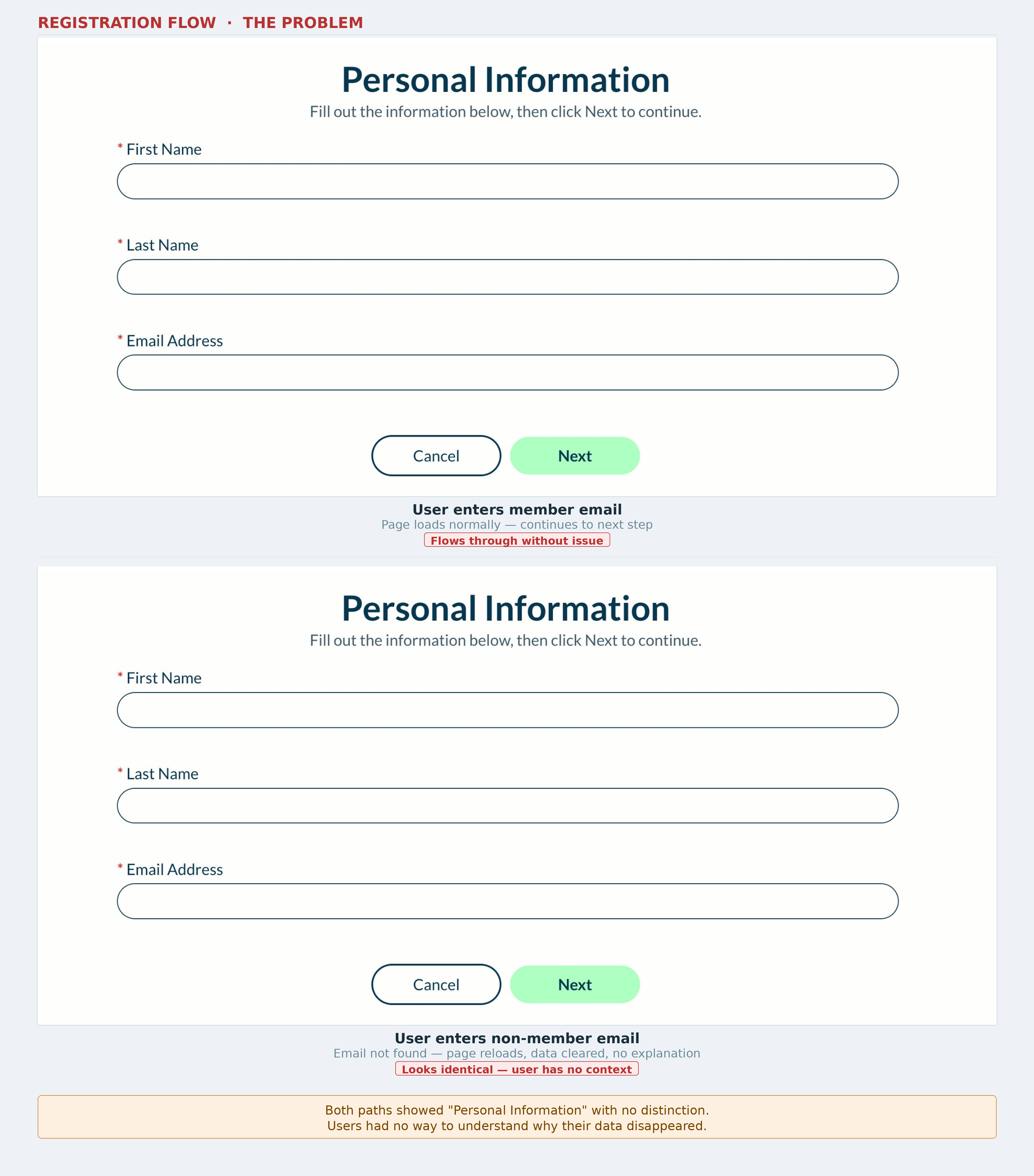
  • Users entered personal information

  • The page refreshed unexpectedly

  • Entered data disappeared

  • The layout remained visually identical

User perception:

Something broke - or they made a mistake. This created confusion, loss of trust, and abandonment at a key conversion step.
Contraint

The system was already live and could not be restructured.

I could not:

  • Prevent the page refresh

  • Preserve user input

  • Redesign the flow

Key Insight

This wasn’t a system failure, it was a communication failure.

Users weren’t dropping off because of functionality, but because the system behavior wasn’t explained.

What I Did
Clarified System State Through UX Content

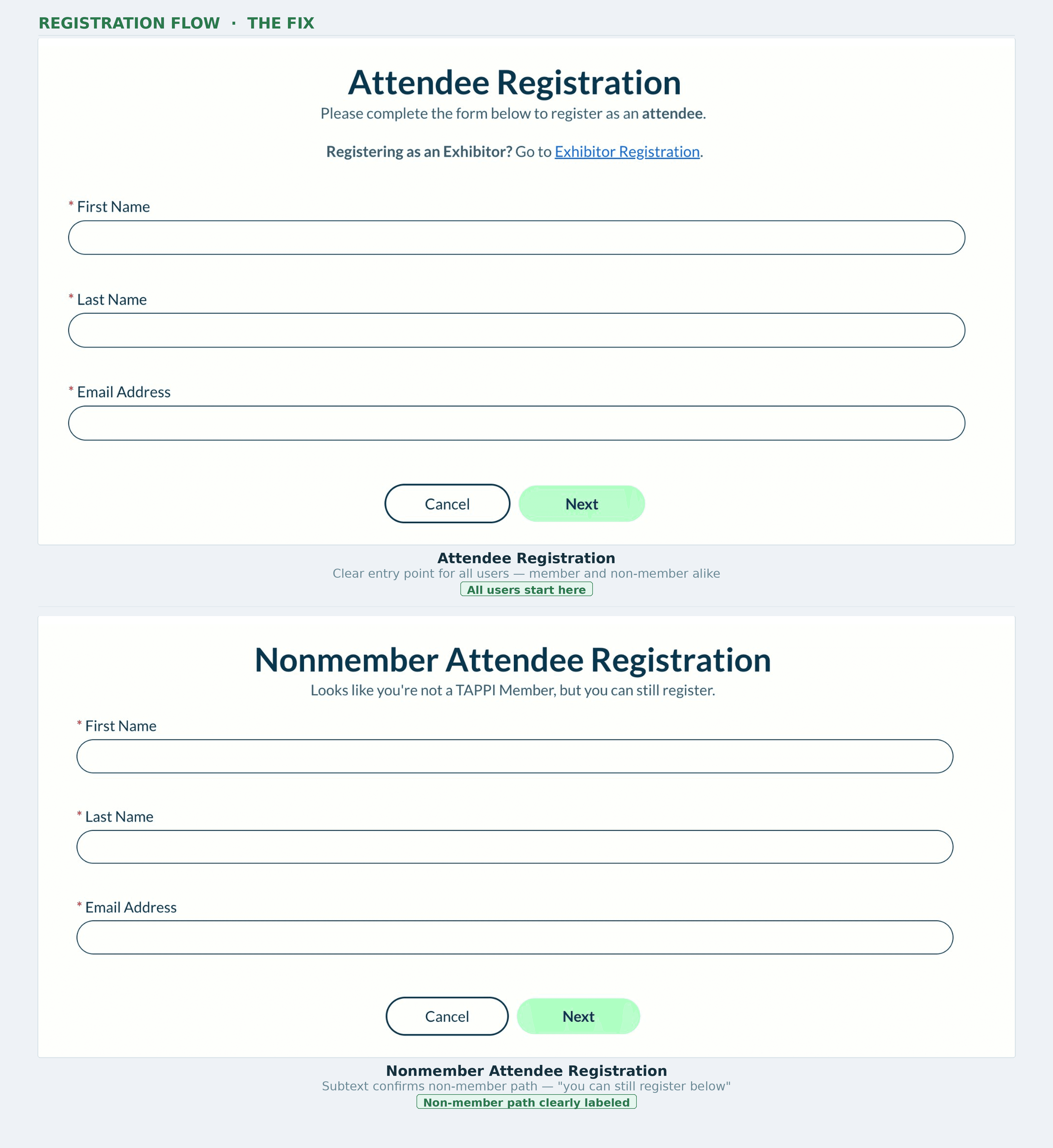
Rewrote page labels and messaging to reflect what was happening in real time:

  • “Personal Information” → “Attendee Registration”

  • On refresh → “Nonmember Attendee Registration”

  • Added message: “Looks like you’re not a TAPPI Member, but you can still register.”

Clarified System State Through UX Content

Rewrote page labels and messaging to reflect what was happening in real time:

  • “Personal Information” → “Attendee Registration”

  • On refresh → “Nonmember Attendee Registration”

  • Added message: “Looks like you’re not a TAPPI Member, but you can still register.”

Removed a Major Friction Point in the Flow

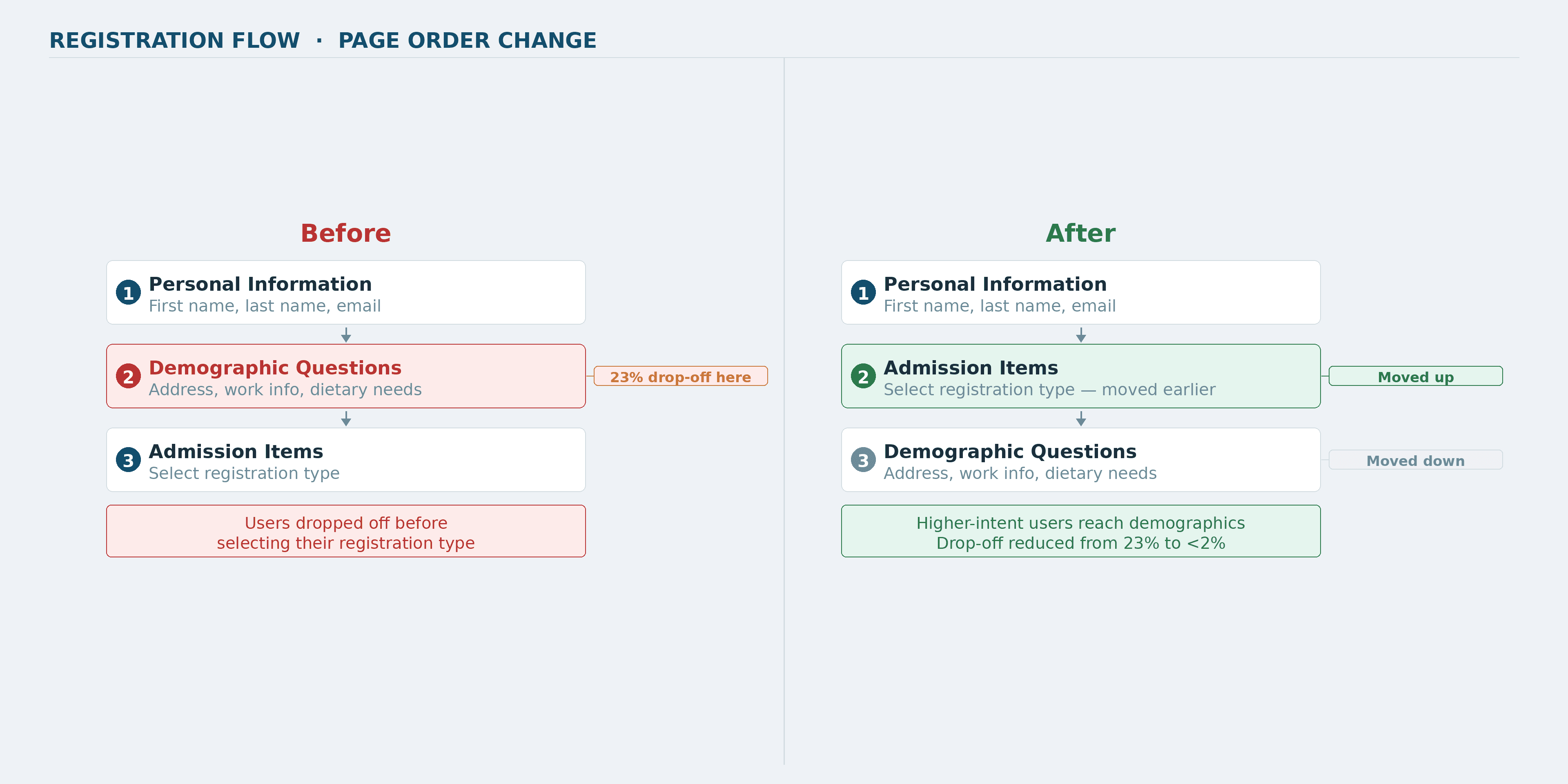
Identified that Demographic Questions were causing unnecessary early drop-off.

  • Moved this step later in the process

  • Ensured higher-intent users reached it

Removed a Major Friction Point in the Flow

Identified that Demographic Questions were causing unnecessary early drop-off.

  • Moved this step later in the process

  • Ensured higher-intent users reached it

Reduced Friction at Critical Decision Moments

  • Explained system behavior clearly

  • Reassured users they were still on the correct path

  • Reduced ambiguity and hesitation

Identified System-Level Issues for Future Iteration

Documented additional friction points:

  • High drop-off still at Personal Information

  • Lack of trust signals

  • No progress indicators

  • Redundant or overwhelming fields

Reduced Friction at Critical Decision Moments

  • Explained system behavior clearly

  • Reassured users they were still on the correct path

  • Reduced ambiguity and hesitation

Identified System-Level Issues for Future Iteration

Documented additional friction points:

  • High drop-off still at Personal Information

  • Lack of trust signals

  • No progress indicators

  • Redundant or overwhelming fields

Impact

Measured Improvements

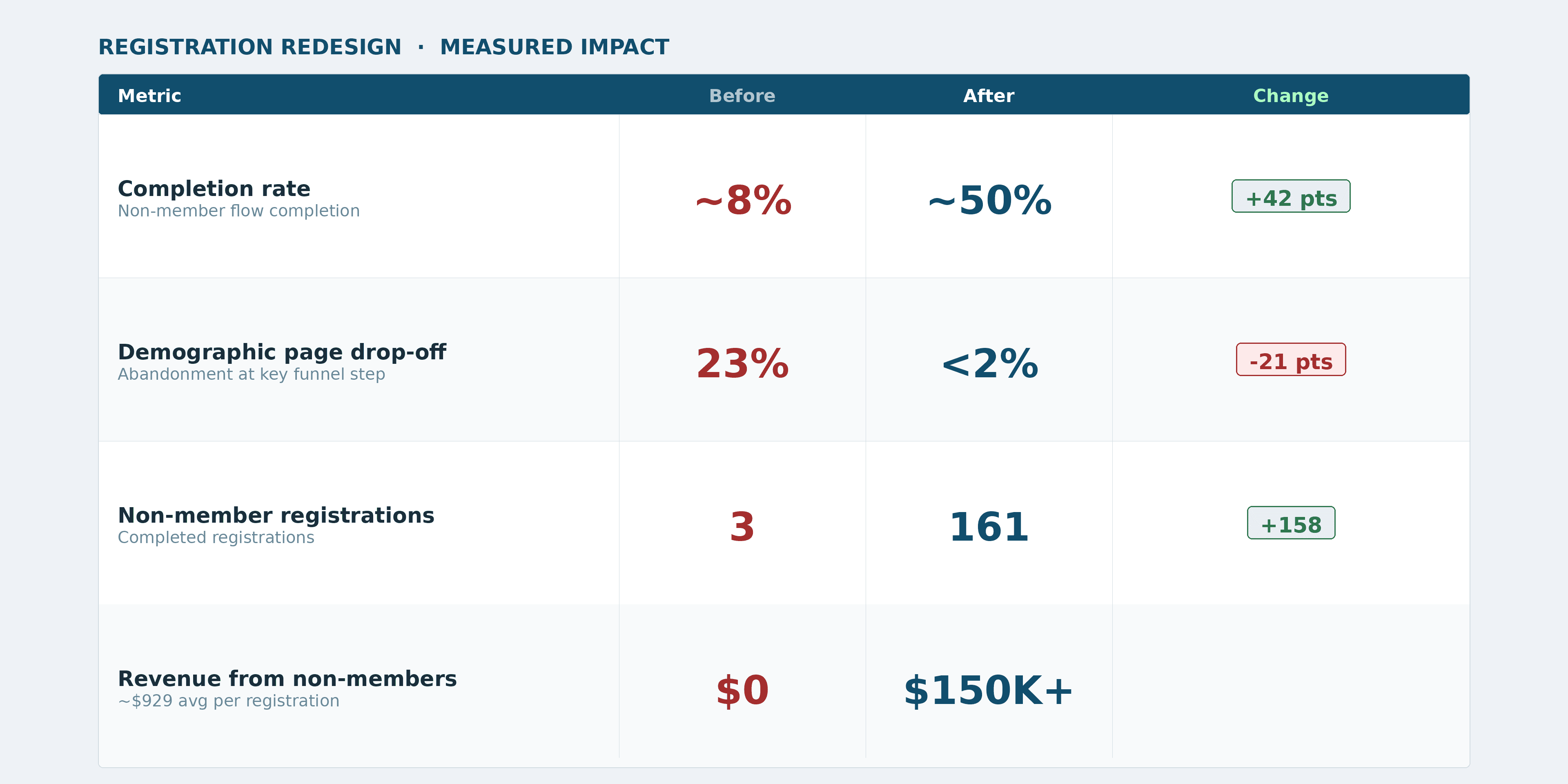
  • Non-member completion rate increased from ~8% → ~50%

  • Demographic page abandonment reduced from 23% → under 2%

  • Non-member registrations increased from 3 → 161 completions

  • ~$150K+ in revenue generated from non-member registrations (~$929 avg)

These numbers reflect a mid-cycle intervention - the baseline was captured early in the registration window. While timing contributes to volume increases, the completion rate and drop-off improvements are behavioral metrics that are less sensitive to timing and more directly attributable to the design changes.

Behavioral Impact

  • Reduced confusion at a critical conversion step

  • Increased user confidence in the registration process

  • Improved flow efficiency by removing early friction

What Remains (and Why It Matters)

  • 83% of non-member drop-off still occurs at Personal Information

This highlights a larger structural issue that could not be addressed within system constraints, including:

  • Too many required fields

  • Lack of trust-building elements

  • No progressive disclosure


Measured Improvements

  • Non-member completion rate increased from ~8% → ~50%

  • Demographic page abandonment reduced from 23% → under 2%

  • Non-member registrations increased from 3 → 161 completions

  • ~$150K+ in revenue generated from non-member registrations (~$929 avg)

These numbers reflect a mid-cycle intervention - the baseline was captured early in the registration window. While timing contributes to volume increases, the completion rate and drop-off improvements are behavioral metrics that are less sensitive to timing and more directly attributable to the design changes.

Behavioral Impact

  • Reduced confusion at a critical conversion step

  • Increased user confidence in the registration process

  • Improved flow efficiency by removing early friction

What Remains (and Why It Matters)

  • 83% of non-member drop-off still occurs at Personal Information

This highlights a larger structural issue that could not be addressed within system constraints, including:

  • Too many required fields

  • Lack of trust-building elements

  • No progressive disclosure


Create a free website with Framer, the website builder loved by startups, designers and agencies.